 visit Auburn.edu
A panel of experts at The Winchester Institute’s 2026 Real Estate Outlook event shared an optimistic forecast with signs of renewed interest in quality office space, plenty of investment capital ready for intriguing projects, lower interest rates, and in some markets a fresh perspective on former go-to retail attractions such as shopping centers.
Auburn University’s Winchester Institute, supported by the Harbert College of Business and the College of Architecture, Design and Construction, sponsors a series of events each year that connects the university and industry professionals in the real estate community.
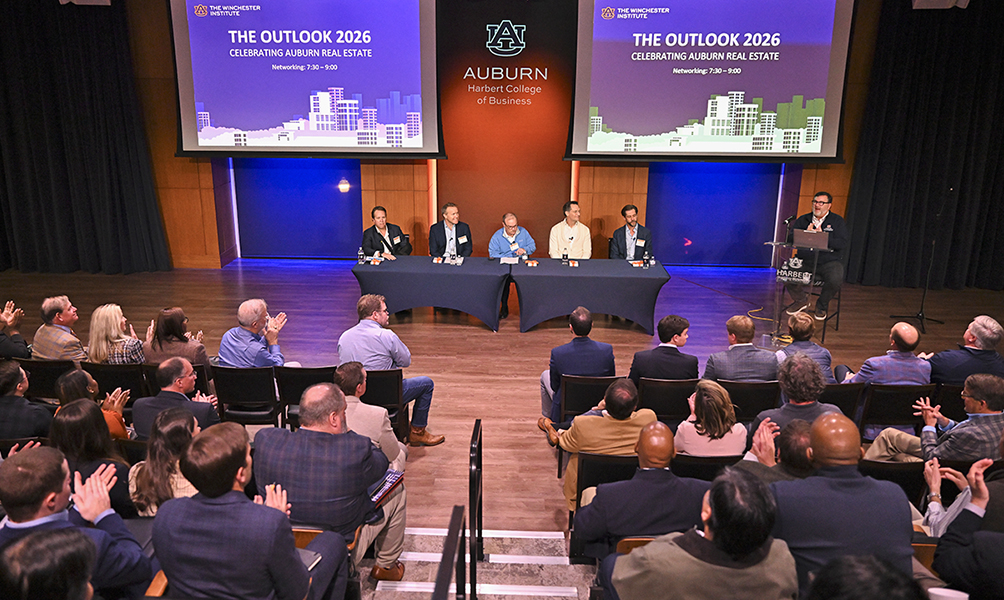
The annual Outlook event addresses trends and expectations for the year ahead, and it was a full house on hand for the 2026 gathering.
“If this isn’t the largest, it’s one of the largest crowds we’ve ever had at this symposium,” said John Benner, the Institute’s executive director.
The five-member panel included a representative of five distinct fields interested in real estate matters: office, retail, industrial, multi-family and capital markets.
 |
Jeff Eckert – Office
Eckert is president of Americas Agency Leasing for JLL, a global professional services firm specializing in real estate and investment management. He feels the office sector in real estate “is at an interesting time.”
“Obviously, we were kind of kicked in the teeth when the pandemic started in March of 2020,” Eckert said, referring to the beginning of an historic era when many offices closed their doors or implemented strict limits on office attendance to help prevent the spread of COVID-19.
That led to a new trend of employees working remote, a trend that has proven slow to reverse itself and leaving vacant office space surpluses in many markets. That trend, he said, has reversed itself with office attendance on average across the U.S. at four-plus days per week.
However, “we started to see real momentum” in 2024 and into 2025, not just in the number of transactions but the size of transactions, he said. “We think that will continue in 2026.”
The market for leasing office space continues to define itself regarding today’s supply-and-demand considerations. Investors must decide what is good real estate, what office space is worthy of renovation, and what will be filled based on factors in tiers ranging from new construction to those that could be labeled as obsolete.
Upscale, remodeled and newer office space seems on the right track, while there remains a mix of approaches to plentiful middle-tier space. Investors face decisions, he said, such as having a property that might be considered good real estate, but are there issues with investing capital in it?
Among other observations after the pandemic, “call centers likely are not coming back to occupancy levels that we once saw,” Eckert said.
Looking ahead, he views artificial intelligence as a positive, with AI tools “cutting hours and hours out of the process,” to which, Eckert says, “We are giving back time to our brokers to interact with customers, and with more time, we can make more revenue for our clients and our brokers.”
Miles Theodore – Retail
Theodore, a managing director of real estate investment with the firm Eastdil Secured, traced history in the retail sector back to around 2017, “when everyone wanted to talk about e-commerce.”
Some asked, “will anyone ever want to go to a shipping center again?” he said, or, “Why would I want to go shopping in a mall?”
Then in 2023 the market began to see “enormous change in attitudes,” with more investment and positive outlooks “we really hadn’t heard in 8-10 years.”
“That was a very, very, favorable trend line that we saw in 2025... We hope to see it continue in 2026,” Theodore said. “We took our licks in the retail space, but now it’s starting to pay off.”
Investors began asking, “how do you get people off e-commerce and out to your shopping centers?” They began looking at projects as more of social gathering spaces, providing more food and beverage services, and developing places “where communities can gather and get away from the screens,” he said.
Box retailers also are looking at providing additional services, such as PetSmart offering veterinary services to lure more people inside their stores.
Other investors are looking at data centers, health care, telecable and fiber, and farmland, he said.
Gardner Lee – Industrial
Lee is principal and co-founder of Growth Capital Partners, a Birmingham-based private real estate investment and management company, and he offered a different reflection on 2025.
From 2015 to 2023, “we were the beneficiaries of e-commerce, so that was a nice ride for us,” he said, but coming into 2024-25, “we really had a slowdown.”
“The big change for us in 2025, and really for the first time since the Great Recession, we started to have oversupply in markets. We really hadn’t had that in a long time,” Lee said, pointing to significant increases in vacancy rates except in strong markets such as Dallas and Houston.
Finding space for warehouse projects can be challenging, he said, because of all the consumption for data centers. “It’s a significant impact.”
His company today looks for projects “a bit contrarian” to normal trends, Lee said, where “we try to get in front of that herd” looking for niches “where the institutional player doesn’t want to be there.”
Phillip Smith – Multi-Family
Smith is founder and president of Framework Group and leads its efforts and strategic plans for developing diverse multi-family housing projects throughout the Southeast.
“In the multi-housing world... we had a huge amount of supply come into the pipeline post-COVID,” he said. After weathering the storms, “just now at the end of this year, we’re starting to see the light at the end of the tunnel, a light that we thought we’d see a year ago.”
More multi-family deals are getting done, and especially in markets with rent growth, he said, but “it’s been mostly headwinds in the multifamily housing world. It will probably take until the end of this year to come out of that supply glut, in my estimation.”
Affordability is a factor, Smith said, as investors and consumers weigh benefits between ownership and rental.
Renters who are “economically healthier,” he said, are being lured by landlords using tactics such as giveaways and fringe benefits.
Bobby Norwood – Capital Markets
Norwood works as a managing director with JLL Capital Markets and said in 2025, “we started to see the banking sector get back in the game.”
Retail, multi-family housing and office real estate are making good recovery, he said. “Retail has been absolutely on fire.”
Lender activity is up and perhaps most significant going into 2026 is the amount of capital sitting on the sidelines, with one projection of “$1.2 trillion that are trying to get into the game.”
“The debt market had an amazing year,” Norwood said, “driven by a ton of refinance activity.”
Regarding equity, “some of it, if you don’t use it, you’ve got to give it back, and nobody wants to do that,” he said, predicting more investment confidence in other sectors as well, such as office space and manufacturing housing. “I think that’s where you’re going to see the dollars flow; people picking a horse and making a bet.”
JLL also is investing heavily in technology, Norwood said, to the tune of about $400 million. He looks for it to save time to redirect personnel to more important duties.
“We have to process wild amounts of information, pretty quickly,” he said. “It is in no way, shape or form replacing the analyst... but changing the analyst’s job... making us drastically more efficient.”
Another Winchester Institute success
Greg Winchester, the founder of Winchester Institute, was in attendance for the event and said he was impressed with the insight shared, noting a few market observations of his own.
 |
|
Greg Winchester (left) speaks with panelist Bobby Norwood of JLL Capital Markets at
the Outlook 2026 event. |
“I really enjoyed learning more about the acceleration of office leasing in the higher quality office developments and how the market recovery has begun,” he said. “It will take a long time to clear a lot of the Class B and Class C product, but this is a bright beginning.”
Looking into 2026, “there is a lot of capital on the sidelines waiting to buy nicer products, particularly multi-family. I’m hopeful that with lower interest rates and cap rates, this capital will be unleashed and help rebalance the market,” Winchester said. “The slowdown in the deliveries in 2026 and 2027 along with supply/demand dynamics coming in line makes this a real possibility.”
He praised Auburn’s organizers of the session and those who participated.
“This is one of the landmark annual events of the Institute in terms of industry engagement, and I believe it’s our sixth one,” Winchester said. “It was terrific to see many leading industry practitioners, students and faculty engaging with each other throughout the evening.
“The Institute is becoming a premier institution for the real estate industry in the Sunbelt to connect. I thought this was our best Outlook panel event to date and am grateful for the leadership of John Benner and the Institute team for making it a success!”
###