 visit Auburn.edu
 |
|
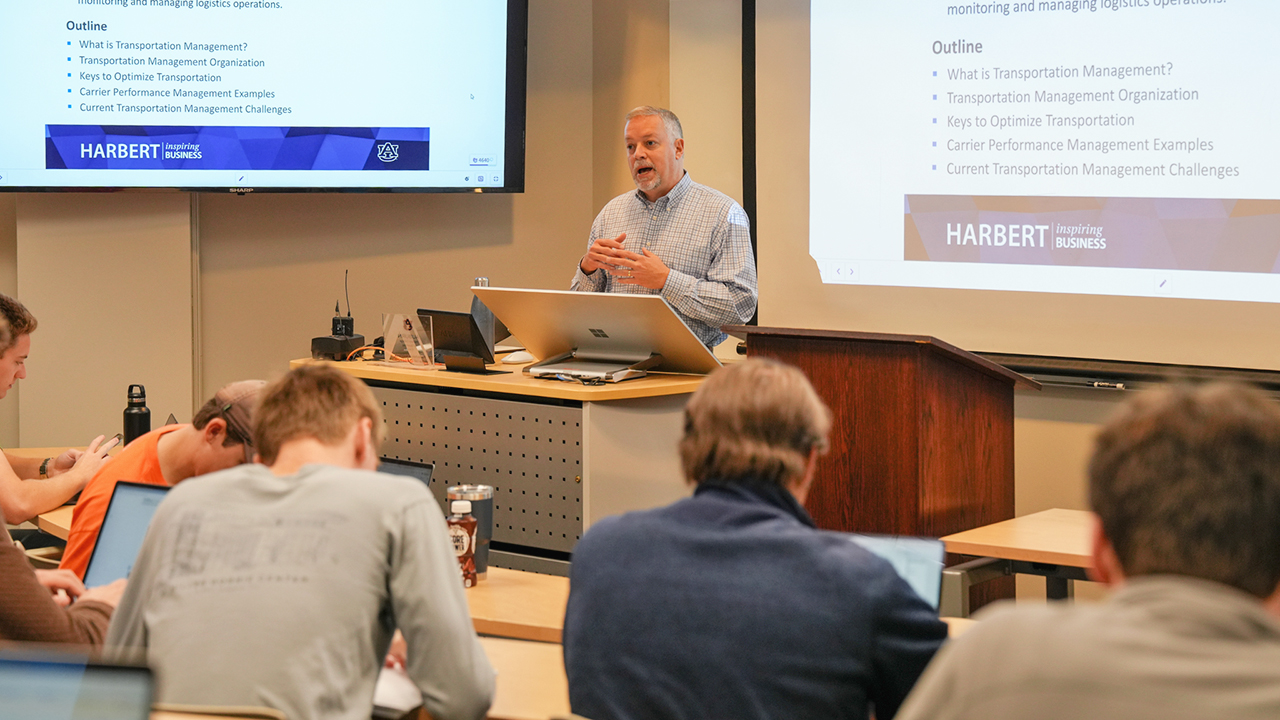
Harbert lecturer Barry Russell incorporated anti-trafficking instruction into his transportation and fulfillment class recently, educating 56 supply chain management students on the topic. |
An Auburn University lecturer has incorporated the battle against human trafficking into his supply chain management classes, inspired by a heart-tugging personal ministry in South America.
Barry Russell is a lecturer at Auburn’s Harbert College of Business, primarily teaching transportation-related courses such as transportation strategy and analytics in the Department of Supply Chain Management.
“Human trafficking affects an estimated 50 million people globally,” Russell said. “Luckily there are great organizations like Truckers Against Trafficking that are committed to educate, equip, empower and mobilize people in transportation and other key industries to identify and combat human trafficking.
“[Recently] 56 students in my transportation and fulfillment class passed the TAT training course... mobilizing an army of everyday heroes.”
It’s happening everywhere
Truckers Against Trafficking, established in 2009, started with a simple yet powerful belief: that every truck driver can be a crucial ally in the fight against human trafficking.
Since then, the non-profit has grown to encompass a greater portion of the transportation industry, forming deep alliances to raise awareness about human trafficking, who it targets and signs of trouble.
Russell, originally from Birmingham, graduated from Auburn in 1991, majoring in aviation management. He worked in logistics and supply chain before becoming a Harbert College lecturer in 2021.
He has more than 28 years of experience as a practitioner developing supply chain strategies and managing operations for technology manufacturers and telecom service providers.
Russell’s interest in the fight against human trafficking stems from a personal connection.
“I am involved with a ministry in Ecuador, called Dunamis, that helps restore young girls that have been rescued out of human trafficking situations, so this is an issue that is absolutely on my heart,” he said. “It is a crime that takes advantage of young children that aren’t able to defend themselves and it is happening in our own communities.”
Running with a good idea
When Russell learned about Truckers Against Trafficking, he immediately saw the value of including the certification course in his supply chain management classes at Harbert.
“I think I first noticed TAT on LinkedIn and then saw that one of my colleagues at Mississippi State taught the TAT training in his undergraduate transportation course, so I immediately got inspired to fit it into my course,” he said. “Basically, I use the certification training that TAT offers on their website and we spend about 45 minutes completing it in class.”
He praised the program for its far-reaching influence on American highways.
“TAT is a non-profit that focuses on combating human trafficking by offering truck drivers free awareness training,” Russell said. “They are leveraging the fact that truck drivers are in a unique position to identify signs of potential trafficking. TAT mostly works with trucking carriers but have expanded their training for other related industries.”
An example of how the program has helped recently was reported after a truck driver working for a Madison, Alabama, company, was praised as a hero for having intervened and called for help in what he suspected was a victim fleeing from an abduction.
The trucker had taken the Truckers Against Trafficking course at his company, MCK Trucking Inc.
The program is a natural fit for supply chain students, Russell said.
“Many students will be supervising and managing drivers soon, so I know that has immediate, very far-reaching potential. And it’s also likely they will work for more than one trucking company in their career, so that could also expand the reach of the training over time,” he said. “And for the others, awareness is a great thing.”
Barry Russell, lecturer Harbert College of Business
“All of my students will now be more keenly aware of the signs of trafficking, what details to take note of and who to call. I suggested they all add the Trafficking Hotline to their contacts on their phone,” he added.
A student’s praise
Erika Ross, a junior pursuing a major in supply chain management with a minor in finance, shared high praise for the opportunity to experience the program in class.
“One thing I really appreciate about the Auburn supply chain management program is how strongly our professors stay connected to real industry practices, because most if not all of them have industry experience,” she said. “Throughout the curriculum, we are constantly exposed to best practices and the realities of what supply chain professionals face.
“Before taking Professor Russell’s class, I had very little insight into the intricacies of the trucking or transportation industry because it had never been laid out for me in such a practical way,” Ross said. “Professor Russell dedicated an entire class session to the Truckers Against Trafficking program, and I am so grateful he did. It was really eye-opening to learn how supply chain professionals, especially those in trucking, can play a critical role in identifying and preventing human trafficking.”
The course also emphasizes the ethical impact the industry can have, she said.
“This program has equipped me with knowledge I know I will carry throughout my career and my personal life,” Ross said. “This training enabled me to be more attentive, informed, and willing to act when something does not seem right.
“At the end of the day, we are not just professionals, we are also citizens. We are part of a network that can directly contribute to safety, vigilance and human dignity.”
Erika Ross, supply chain management major
###